
Amaravati
A ruined Buddhist stupa on the Krishna's right bank
An Amaravati stupa visit combines a Buddhist monument raised from the 3rd century BCE to roughly 250 CE, a site museum and a Shiva temple on the Krishna.
Overview
The Amaravati Stupa, a Buddhist monument beside the Krishna River in the village of Amaravati, took shape over several centuries, from the 3rd century BCE to roughly 250 CE. It suits travellers with an interest in early Buddhist art and archaeology, and October to February gives the milder weather, with highs around 35 C. The village is listed in Palnadu district, although many guides still place it in Guntur district. No railway line reaches it, so the journey is by road, with APSRTC buses from Vijayawada, Tenali and Guntur.
What stands today is a ruin under the protection of the Archaeological Survey of India. How it began is uncertain: Ashoka's reign has been suggested for the foundation, but nothing decisive supports that date, and later phases are linked to the Satavahana rulers. The monument once carried limestone slabs and granite railing pillars. A few railing pieces and lotus medallions are set around the mound, while most of the finest carving left long ago and is now in the Government Museum in Chennai and the British Museum in London. The surveyor Colin Mackenzie first came here in 1797.
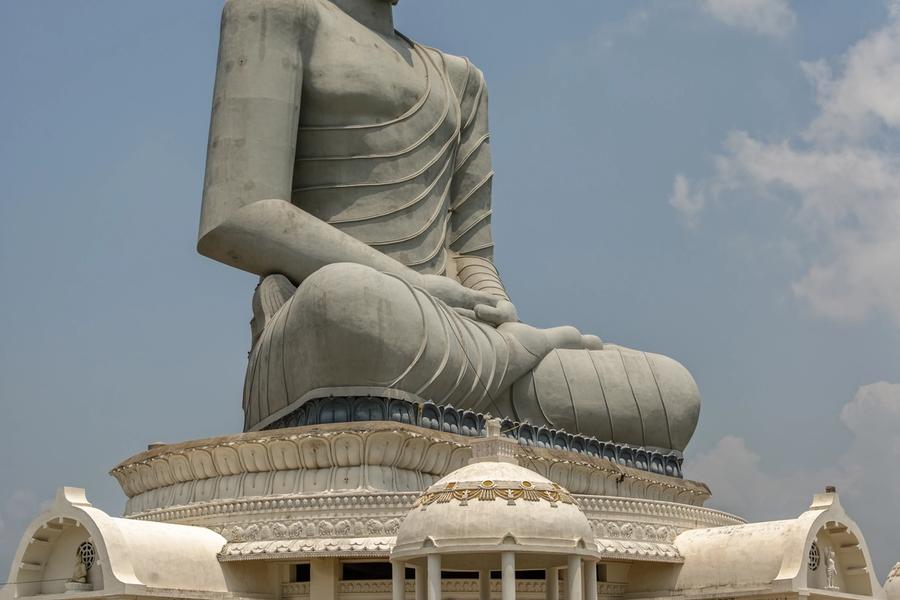
Next to the mound, a museum shows what stayed on site; it dates from 1956. A short distance away is the Amareswara Temple, a Shiva shrine counted among the Pancharama Kshetras, and the village also has a 125-foot Dhyana Buddha statue, so Buddhist and Hindu sites sit in the same small place.
A planned city of the same name is a separate matter from the village. Its area covers about 217 km² on the river's right bank, roughly 15 km south-west of Vijayawada, and its foundation stone was laid on 22 October 2015. Treat anything beyond the heritage site as subject to change, and look at current official notices before building a visit around the new city area.
Plan a half day for the stupa, museum and temple, longer if you add the Undavalli caves covered under Vijayawada. Vijayawada Airport at Gannavaram (VGA) is about 41 km from the planned city's centre, and the stations at Vijayawada and Guntur are the usual rail points.
Known for
A Buddhist monument raised in stages, from the 3rd century BCE to roughly 250 CE
Quick facts
October to February stays moderate, with temperatures between about 11 C and 35.5 C.
Vijayawada Airport (VGA), Gannavaram, about 41 km from the planned city's centre
Vijayawada Junction (BZA); Guntur Junction (GNT) is the other main station
The Vijayawada to Amaravati road links the village with Vijayawada, Tenali and Guntur, and APSRTC buses run from those towns. The planned city lies about 15 km south-west of Vijayawada and 33 km north of Guntur.
Go to the Government Museum in Chennai or the British Museum if you want the best Amaravati sculpture, since most of it left the site long ago
Plan a road journey, because no railway line reaches the village
Ask locally about the museum's current timings before you travel, as no official page was readable
Packages that visit Amaravati
All packages → 3D / 2N
Buddhist Amaravati and Vijayawada
Amaravati Buddhist tour package: 3 days by private car from Vijayawada Airport to the Amaravati Stupa, Undavalli caves and Kanaka Durga Temple.
Plan a trip to Amaravati
Tell us your dates and we will shape the route.